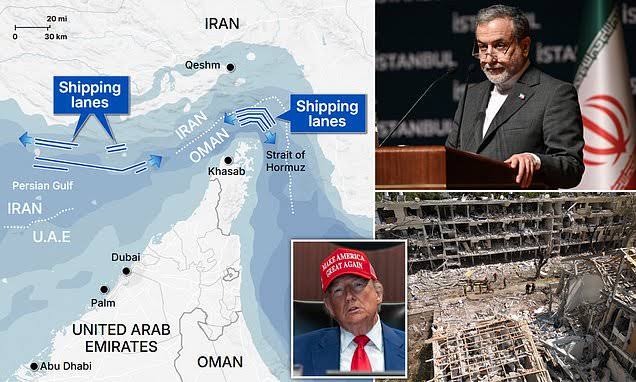

Imagine waking up to the news that the world’s most critical oil artery may be choked off—sending global markets into a frenzy and raising fears of yet another war in the Middle East.
That’s exactly where we stand today.
In a dramatic escalation of geopolitical tensions, Iran’s parliament voted on June 22 to close the Strait of Hormuz—a narrow but immensely strategic maritime chokepoint through which one-fifth of the world’s oil and gas supply flows every day. While the move is not yet law, its implications are immediate and profound.
Why the Strait of Hormuz Matters
Sitting between Iran and Oman, the Strait of Hormuz is only about 21 miles wide at its narrowest point. But its global importance is colossal.
Every single day, over 17.8 to 20 million barrels of oil, and nearly a quarter of the world’s liquefied natural gas (LNG), pass through this bottleneck. Major economies—China, India, Japan, the EU, and even the U.S.—depend heavily on its safe passage.
The Strait isn’t just a shipping lane; it’s the world’s energy pulse.
What Prompted Iran’s Move?
This dramatic move follows a series of U.S. and Israeli airstrikes on Iran’s nuclear facilities, reportedly damaging key enrichment sites at Natanz, Fordow, and Isfahan. Tehran responded with fury, seeing the attacks as acts of aggression and violations of its sovereignty.
In a fiery session, Iranian lawmakers declared that they could no longer guarantee free passage through the Strait if their sovereignty continued to be undermined. The vote was symbolic—but potent. The final decision now lies with Iran’s Supreme National Security Council.
Is Iran Serious About Shutting the Strait?
Notably, this isn’t the first time Iran has threatened the Strait. But this time feels different.
Military experts warn that Iran has the means to make good on its threat—naval mines, missile systems, fast-attack boats, submarines, and drone swarms could all be used to disrupt shipping lanes without fully blocking them. This kind of “gray zone” warfare would create maximum chaos while staying just below the threshold of triggering full-scale war.
That said, such a closure would be legally dubious under international maritime law and strategically dangerous—even for Iran. Much of Iran’s own oil exports also pass through the Strait, and its key ally China relies heavily on those flows. Any actual closure would risk military retaliation and economic self-sabotage.
Global Markets React — Oil Spikes
The impact on global markets has been swift:
• Brent crude surged to over $80 per barrel, with analysts warning prices could hit $100–110 or even $130+ if a prolonged disruption occurs.
• U.S. gasoline futures jumped over 6%, with American drivers facing potential pump price hikes of 20–30 cents per gallon.
• LNG prices also climbed, with no viable alternative route for Gulf gas exporters like Qatar.
Goldman Sachs warned of a “$12 geopolitical risk premium” being baked into oil prices—and that’s assuming a standoff, not a war.
Who Gets Hurt First?
While a closure would hurt everyone, some nations would feel the burn faster:
• Import-reliant economies like Japan, South Korea, and India would face fuel shortages and inflationary pressure.
• Gulf producers like Saudi Arabia, Iraq, and the UAE would see their main export route choked.
• Even Iran could see its oil revenues collapse if buyers like China and Syria cannot receive shipments.
In short: Iran may have the gun, but it’s pointing it at a crowded room that includes itself.
U.S. & Allied Response
The U.S. Navy’s Fifth Fleet, based in Bahrain, has long prepared for this scenario. Warships, drones, and satellites are already tracking Iranian movements. Officials have warned that any attempt to block the Strait would be “economic suicide for Iran”—and that the U.S. will act to ensure freedom of navigation.
Military experts agree: a full closure would likely be met with swift and forceful intervention, potentially igniting a wider regional war.
The Bigger Picture: Leverage, Not Lunacy?
Most analysts agree that this move is strategic brinkmanship. Iran’s goal isn’t necessarily to blockade the Strait but to signal resolve, increase its diplomatic leverage, and deter future attacks.
Still, the risks are real. Miscalculations or rogue actions could spiral out of control. And in an already volatile region, a single drone, a misfired missile, or a sunken tanker could be the spark that sets the Gulf ablaze.
What Happens Next?
The world watches with bated breath as the following questions unfold:
• Will Iran’s Supreme National Security Council authorize a real closure?
• Can backchannel diplomacy—perhaps involving China, Russia, or Gulf States—defuse the crisis?
• How far will the U.S. go to prevent any disruption to oil supplies?
Final Thoughts
Iran’s move to potentially shut down the Strait of Hormuz is a bold, dangerous, and calculated high-stakes gambit. It’s a reminder of how deeply interconnected energy security, geopolitics, and economic stability truly are.
The coming days will test not only the nerves of global markets but also the strategic patience of world powers. Will this be another flashpoint that fizzles—or the beginning of something much more combustible?
More details as it unfolds............